

Collection Priority
Score ranges, scoring factors, what the score is and is not, and the FAQ.
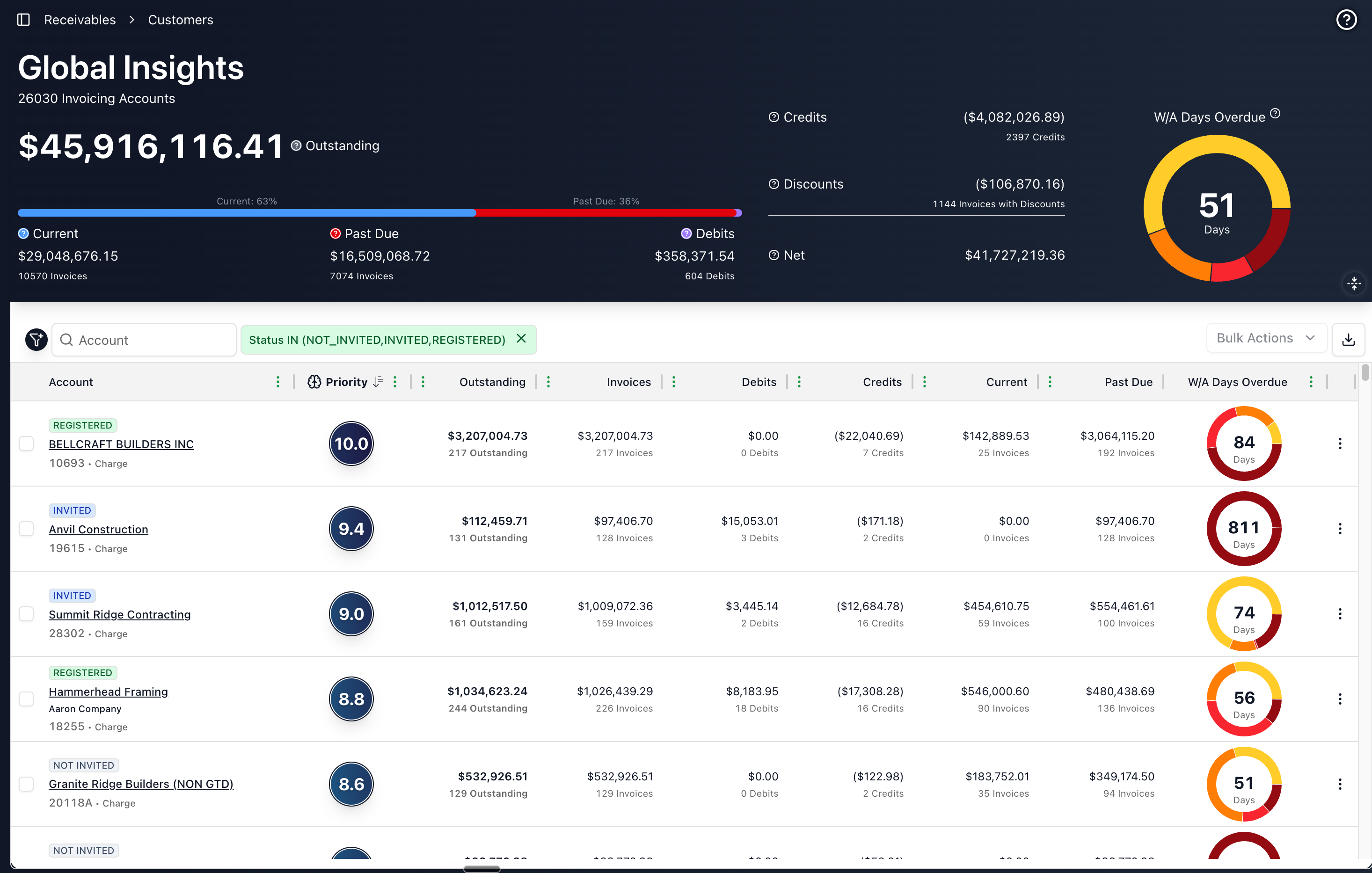
Collection Priority is Drypowder's account scoring model. It assigns each customer account a numeric score from 0 to 10, ranking how urgently the account needs collections attention. Higher scores mean higher urgency. In the product it appears as the Priority column on the Customers Dashboard, with a Smart Priority filter.
Score range
| Score range | Urgency | Meaning |
|---|---|---|
| 8–10 | Highest | This account needs attention now. Significant balance, deep aging, or both. |
| 5–7 | Moderate | Worth monitoring. Something is shifting (aging crossed a threshold, balance growing). |
| 2–4 | Low | Account is generally on track. Normal payment behavior. |
| 0–1 | Minimal | Account is in good shape. No action needed. |
What drives the score
Collection Priority is based on a single signal: each account's impact to your dealership's Weighted Average Days Overdue (WADO).
| Signal | What it measures |
|---|---|
| Weighted average days overdue | A single number capturing both how overdue the account is and how much of the balance is overdue. Accounts whose past-due exposure contributes more to WADO score higher. |
Because the score is dollar-weighted by overdue duration, it already reflects both how much an account owes past due and how old that balance is, without scoring those as separate factors.
How to use Collection Priority
Sort by it. The Customers Dashboard defaults to sorting by Collection Priority, highest first. Start at the top of the list each morning and work down.
Watch for changes. An account that jumped from a 3 to a 7 overnight means something changed, probably a balance increase or invoices aging past a threshold. Investigate before it gets worse.
Do not over-interpret small differences. The difference between a 6 and a 7 is not significant. The score is most useful for broad ranking: separating accounts that clearly need attention (8 and up) from those that are fine (0 to 3).
What Collection Priority is not
- Not a credit score. It does not assess creditworthiness or predict whether a customer will default. It measures collections urgency based on current AR data.
- Not static. Scores recalculate as AR data syncs from Spruce. An account that was a 2 yesterday can be an 8 today if a large batch of invoices aged past a threshold.
- Not a replacement for judgment. The score tells you where to look. You still decide what to do, whether that is inviting the customer to the portal, making a phone call, or waiting because you know the check is in the mail.
Frequently asked questions
Can I manually adjust a score? No. Scores are calculated automatically from the AR data. They update whenever the underlying data changes.
Why is a small account scoring high? Total balance is not what drives the score. A small account with deeply overdue invoices will score higher than a large account with current balances, because the score is driven by past-due exposure weighted by how overdue it is, not by dollar amount alone.
How often does the score update? Every time AR data syncs from Spruce (real time for Spruce-integrated dealers), or after a file upload (for file-based integrations).
Related
- How Collection Priority works — Background on the design reasoning.
- Review and prioritize accounts — Using the score in your daily workflow.
- Customers Dashboard reference — Where the score is displayed.